

A provider’s payer enrollment lapsed. No one knew until the denials started arriving — weeks later, for services already delivered.
Cura Consulting Group · Representative Illustration · 2026
This is one of the most preventable losses we see, and one of the most common. A provider is seeing patients, doing everything right clinically. But their enrollment with a major payer quietly expired — a revalidation date nobody was tracking, a credentialing task that fell through when a staff member left.
The provider keeps working. The claims keep going out. And every one of them is now denying, for care that’s already been provided and can’t be un-provided.
By the time the pattern is noticed — because someone finally asks why this payer’s denials spiked — weeks have passed. The revenue for every affected encounter in that window is at risk, some of it past the point of clean recovery. And the fix isn’t fast: re-enrollment takes time, during which the provider still can’t bill that payer.
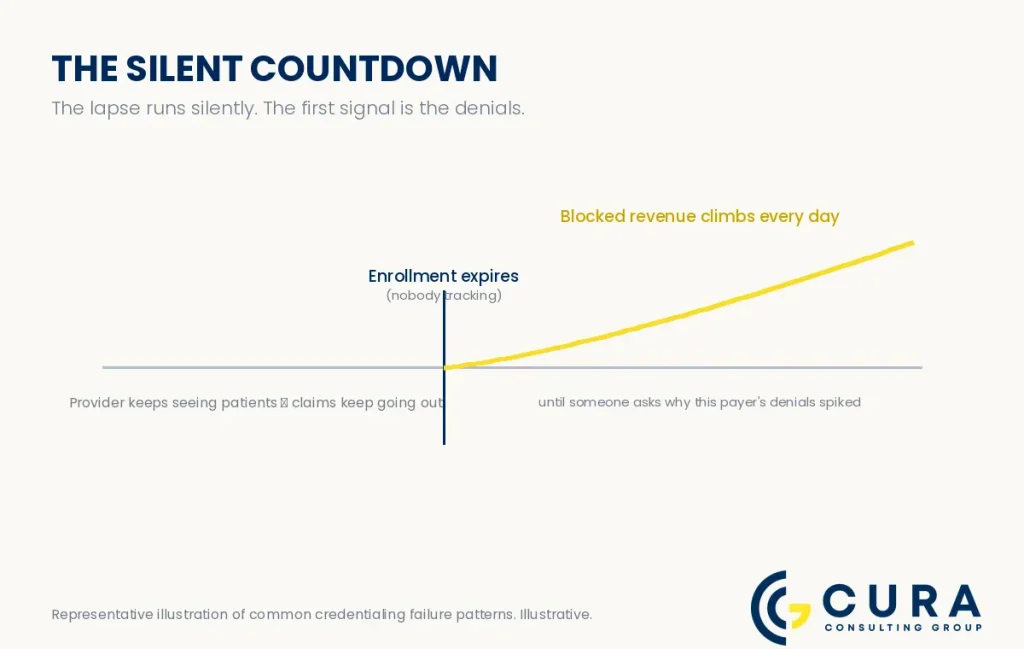
Here’s what makes this failure so expensive: it’s invisible until it’s already costing you. Credentialing status lives in a spreadsheet, or in someone’s head, or in a system nobody checks until there’s a problem. There’s no alarm. The countdown to a lapse runs silently, and the first signal most centers get is the denials — the most expensive possible moment to find out.
The centers that survive this decade won’t be the ones that guessed right about Washington. They’ll be the ones that saw their own numbers early enough to act.
See your credentialing exposure before it costs you.
See your exposure → cura-consulting.com
Representative illustration of common credentialing failure patterns. Figures illustrative. Not financial or legal advice.