

The new location opened on schedule. The revenue didn’t arrive for four months. The costs, of course, started on day one.
Cura Consulting Group · Representative Illustration · 2026
Expansion is where we see centers get financially blindsided by their own success. A new site or service line launches — staff hired, space built out, patients coming through the door. But the revenue-cycle groundwork lagged: payer enrollments for the new location weren’t complete, the new providers weren’t credentialed with every plan, the billing setup wasn’t fully mapped. So the site incurred full cost from the first day and couldn’t clean-bill for months.
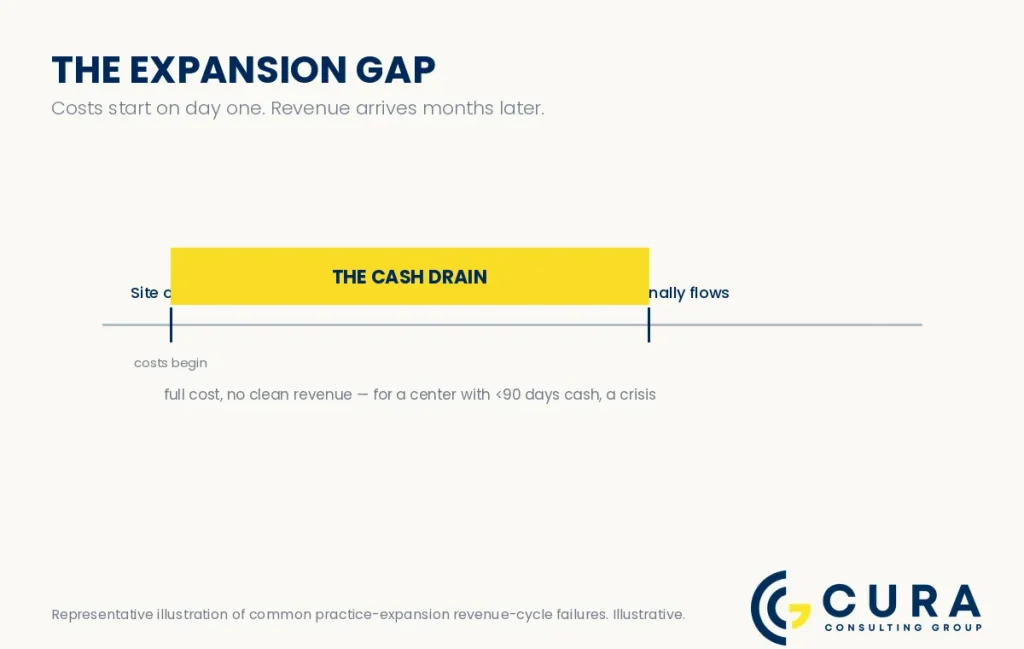
For a center with fewer than 90 days of cash on hand — half of them, nationally — a four-month revenue gap on a new site isn’t a slow start. It’s a cash crisis that can threaten the whole organization, triggered by the very growth that was supposed to strengthen it.
The failure here is almost always sequencing and visibility. The clinical and facility work gets a project plan, a timeline, an owner. The revenue-cycle readiness — enrollments, credentialing, billing setup, clearinghouse configuration — gets treated as paperwork that’ll sort itself out. It doesn’t. And because no one is tracking it against the opening date, the gap is invisible until the site is open and the claims won’t pay.
Centers that expand without a cash scare do one thing differently: they make revenue-cycle readiness a visible, tracked workstream — and see the gaps before the doors open, not after.
Expansion should strengthen a center. It only does when you can see the revenue readiness as clearly as you see the construction schedule. This is exactly the readiness work we build with centers — before they open, not after.
Planning an expansion? This is the readiness work Cura builds — before you open.
Talk to us about expansion readiness → cura-consulting.com
Representative illustration of common practice-expansion revenue-cycle failures. Figures illustrative. Not financial or legal advice.