

Federal health center funding is currently authorized through December 31. It may be extended — it has been before, sometimes at the last hour, sometimes retroactively. But “probably fine” is not a plan, and the strongest boards we see are treating this fall as scenario season.
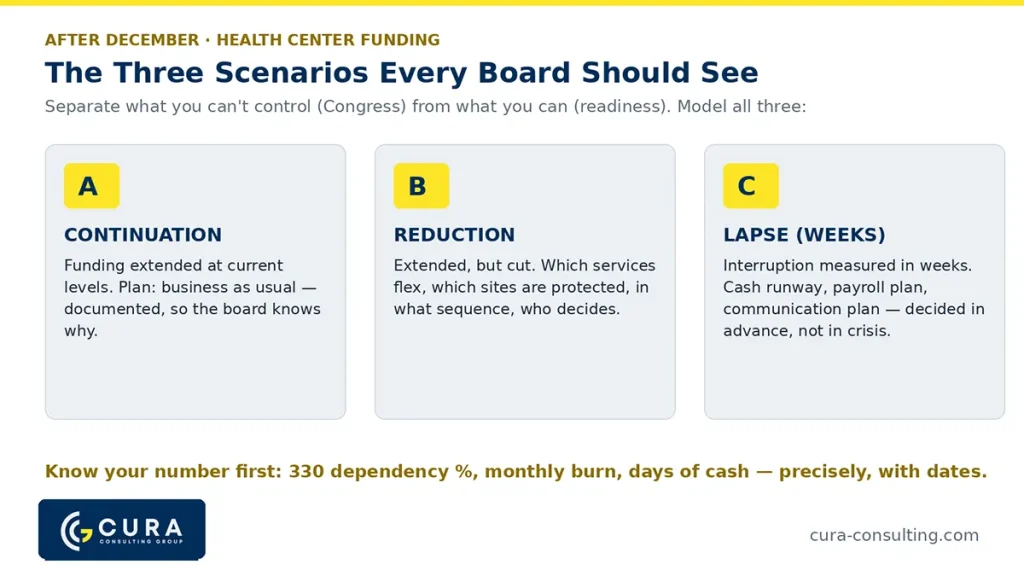
The health centers that navigate funding uncertainty well share a habit: they separate what they can’t control (Congress) from what they can (their readiness for each plausible outcome). That separation turns anxiety into an agenda. Here is what it looks like in practice.
They know their number. Not the grant amount — the dependency. What percentage of operating revenue is federal 330 funding, what the monthly burn looks like without it, and how many days of cash stand between an interruption and a payroll problem. Most executive teams know this roughly. Board-ready means knowing it precisely, with dates.
They model three scenarios, not one. Continuation at current levels; continuation with a reduction; and a lapse measured in weeks. For each: which services flex, which sites are protected, what the communication plan is for staff and patients, and which decisions have to be made in advance because they can’t be made well in a crisis. The plan for a scenario that never happens is not wasted work — it is the reason the board sleeps in December.
They defend the revenue they already earn. Funding uncertainty makes every controllable dollar more valuable. The same quarter that brings the December question also brings Medicaid changes that put patient coverage — and therefore patient revenue — at risk. Renewal support, coverage-retention outreach, and denial follow-through are unglamorous, and in a year like this one they are a sustainability strategy.
And they tell their story now. Health centers that maintain relationships with their congressional delegation, their state association, and their local press in ordinary months are the ones whose story is already understood when it matters. December advocacy starts in September.
One more observation from our conversations this year: leaders sometimes hesitate to bring funding scenarios to their boards, worried it will read as alarm. In our experience the opposite is true. A board that receives a clear-eyed scenario plan gains confidence in management; a board that receives reassurance gains questions. The plan is the reassurance.
December will arrive either way. The only variable is whether it arrives at an organization that already knows what it will do.
Cura builds funding-scenario plans and board briefings for community health organizations — typically in about a week. If your board hasn’t seen one yet, a readiness conversation is a good place to start.