

Something significant is happening in behavioral health financing, and it looks a lot like what happened to community health centers a generation ago: a fragmented field of mission-driven providers is being invited into a structured federal model — with real money, real measurement, and real rules attached. The certified community behavioral health clinic model keeps expanding, new demonstration states keep coming online, and planning-grant cycles keep opening for organizations working toward certification.
For behavioral health and SUD leaders, this is the opportunity of a career. It is also — and this is the part that gets less airtime at the conferences — an operational examination. Certification models pay differently than grants: they pay for defined services, delivered to defined standards, documented in defined ways, reported on defined schedules. The organizations that thrive under them are not necessarily the ones with the deepest clinical excellence. They are the ones whose operations can prove it.
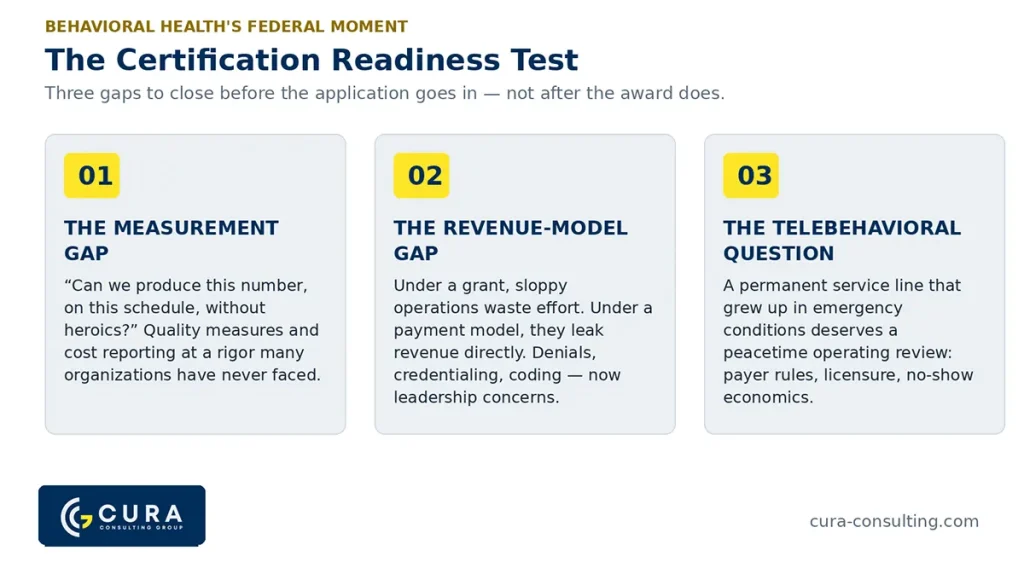
In our conversations with behavioral health leaders this year, three readiness gaps come up over and over.
The measurement gap. Certification and demonstration models run on quality measures and cost reporting that many community behavioral health organizations have never had to produce at this rigor. If your data lives in a clinical record that can’t cleanly report, or in spreadsheets one analyst understands, the reporting burden lands on your scarcest people at the worst times. The infrastructure question — can we produce this number, on this schedule, without heroics? — deserves an honest answer before the application goes in, not after the award does.
The revenue-model gap. Moving from grant funding to encounter- or population-based payment changes what a missed intake, an uncredentialed clinician, or a documentation lag actually costs. Under a grant, sloppy operations waste effort; under a payment model, they leak revenue directly. Behavioral health organizations entering these models need the same revenue disciplines health centers learned the hard way: denial visibility, credentialing calendars, and coding accuracy as leadership concerns, not billing-office trivia.
The telebehavioral question. Tele-delivered behavioral health earned durable status in a way much of telemedicine did not — for many organizations it is now a permanent service line, a workforce strategy, and a rural access model all at once. But permanence brings its own homework: payer-by-payer rules, licensure boundaries, no-show economics, and quality measurement across modalities. A telebehavioral program that grew up in emergency conditions deserves a peacetime operating review.
None of this argues for hesitation. The federal moment is real, the funding is real, and behavioral health has waited decades for both. It argues for pairing every application and expansion with an operational readiness review — the same discipline we’d urge on any organization stepping into a bigger, more measured world. The mission earned this moment. The operations have to keep it.
Cura works with behavioral health and SUD organizations on certification readiness, revenue-model transitions, measurement infrastructure, and telebehavioral operations. A readiness conversation is free and useful either way.