

Somewhere in the last few years, a quiet asymmetry opened up in American healthcare finance: payers industrialized the denial. Claims are now reviewed, flagged, and denied by automated systems operating at machine speed and machine scale — and the pattern-shifts arrive without notice. A code combination that paid cleanly for years starts denying in March. A prior-authorization rule tightens quietly in June. An entire service line’s margin erodes one algorithmic decision at a time.
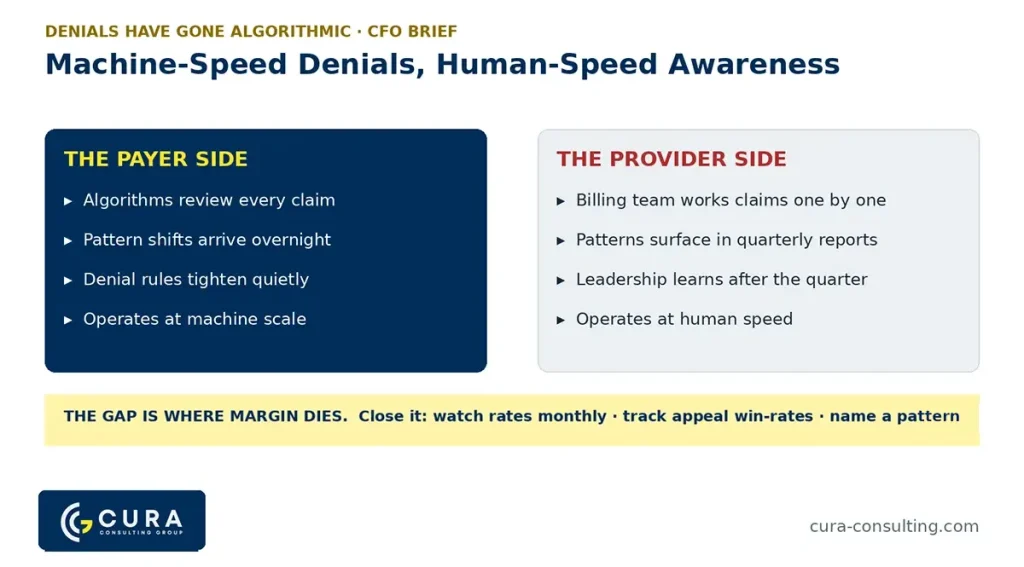
Meanwhile, on the provider side, the information moves at human speed. The billing team sees individual denials daily and works them heroically. But the pattern — the fact that one payer’s behavior changed, that one service line’s denial rate doubled, that appeals are winning at a rate that proves the denials were wrong — often reaches the executive team quarterly, in a report, after the quarter is already lost. That gap between machine-speed denial and human-speed awareness is where margin goes to die.
For community health organizations, the stakes are compounded: thinner margins mean less cushion, smaller teams mean less analytic capacity, and safety-net payer mixes concentrate exposure in exactly the programs — Medicaid and Medicare — undergoing the most change. This is also why the visibility gap is not a billing department problem. It is an executive problem wearing a billing department costume.
The good news is that closing the gap is more about attention architecture than technology budget. Three shifts matter most.
Watch rates, not just dollars. A denial’s dollar value tells you what you lost; the denial rate by payer and service line tells you what is changing. Rate movement is the early warning. Executives should see it monthly at minimum — weekly during payer transitions.
Treat overturned appeals as evidence, not just recoveries. When your appeals win consistently, the denials were wrong. That win-rate is negotiating leverage with the payer, documentation for your association’s advocacy, and — as federal payer-transparency reporting matures — increasingly part of a public record. Organizations that track it are building a case; organizations that don’t are donating margin.
Assign the pattern a name. In most organizations, everyone owns denials and no one owns denial patterns. One person — with a standing fifteen minutes on the executive agenda — who answers a single question: what changed this month, with which payer, and what are we doing about it? That one ritual outperforms most software purchases.
The payers are not going to slow down; the automation on their side of the table will only deepen. The providers who hold their ground will be the ones whose leadership sees the pattern in week two instead of quarter three. In a fight between algorithms and awareness, awareness has to at least show up.
Making this kind of pattern visible to leadership — early, on one screen, without adding headcount — is exactly what Cura builds. If denial behavior has shifted under your organization this year, a readiness conversation is worth thirty minutes.