

A quiet shift is rewiring how community organizations get paid. Food banks invoicing managed-care plans for medically tailored meals. Housing organizations contracting with health systems on transition programs. Community groups delivering transportation, doula support, violence intervention, and care navigation — paid not by a foundation grant, but by healthcare dollars, under healthcare contracts, with healthcare’s expectations attached.
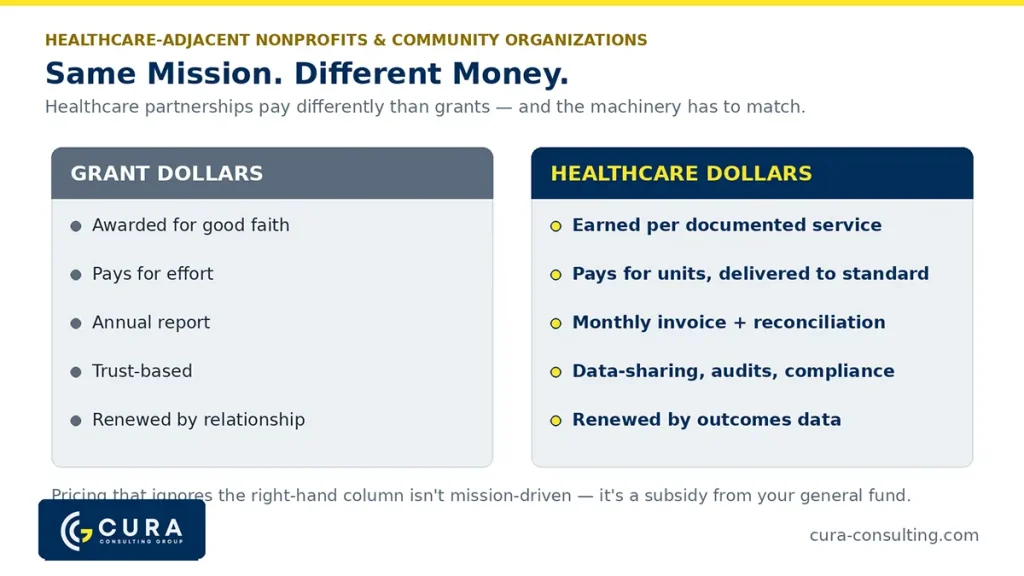
For mission-driven organizations, this is validation decades in the making: the health system finally pays for what communities always knew mattered. It is also a different business than the one most nonprofits were built to run — and the organizations that thrive in it learn the differences early.
Healthcare money is earned money, not awarded money. A grant pays for effort and good faith; a healthcare contract pays for documented units of service, delivered to eligible people, billed correctly, on time. That means referral tracking, service documentation, eligibility verification, invoicing discipline, and reconciliation — capacities many excellent community organizations have simply never needed. The gap shows up as cash-flow pain: services delivered, revenue delayed, staff stretched to produce paperwork the contract quietly required.
Data is now part of the deliverable. Healthcare partners will ask what happened to the people you served — outcomes, utilization, follow-through — and their next contract with you depends on the answer. Organizations that can tell that story with numbers renew and grow; organizations that can’t become a line item someone eventually questions. Building even a modest measurement habit before the first contract is worth more than any brochure.
Compliance travels with the dollars. Healthcare funds bring privacy obligations, data-sharing agreements, background and exclusion checks, and audit rights. None of it is unmanageable, but all of it is real, and the time to understand a data-use agreement is before signing it — not when the health system’s compliance office calls.
Price for sustainability, not gratitude. Nonprofits habitually underprice out of mission instinct. Healthcare partners, to their credit, generally expect to pay real costs — including the administrative machinery above. A rate that ignores that machinery doesn’t make the work more mission-driven; it makes the contract a slow-motion subsidy from your general fund to a health system’s budget.
The organizations getting this right aren’t becoming less community-rooted — they’re becoming community organizations that can meet the health system as equals: clear on costs, fluent in data, tight on delivery. That’s not mission drift. That’s mission durability.
Cura helps community organizations build the operational machinery healthcare partnerships require — contracting readiness, documentation and invoicing workflows, measurement, and compliance basics. The first conversation is free and useful either way.