

When we’re brought into a health center in financial trouble, leadership points to Washington. They are almost always wrong about where the money is actually going.
Cura Consulting Group Analysis · 2026
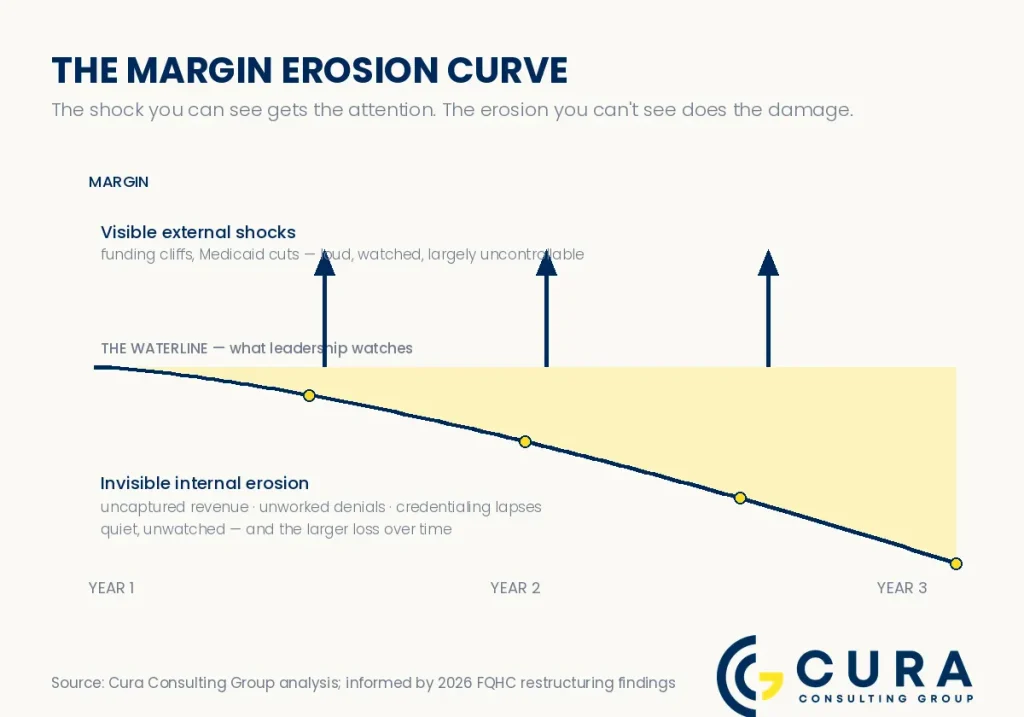
We don’t say that to be provocative. We say it because we’ve seen the same autopsy too many times to call it coincidence. A center is under pressure. The board is consumed by the funding cliff, the Medicaid cuts, the 340B fight. Everyone braces for the external blow. And while they brace, the actual damage is happening somewhere no one is looking — inside their own revenue cycle, quietly, for years.
In a recent restructuring, the team went in certain the losses were driven by federal cuts. They weren’t. The margin had bled out slowly over three years, from internal causes no monthly report ever surfaced. By the time it hit the financials, three years of it were already gone — unrecoverable. The cuts got the meetings. The erosion got the center.
This is the pattern. If you run a health center, assume you have some version of it right now.
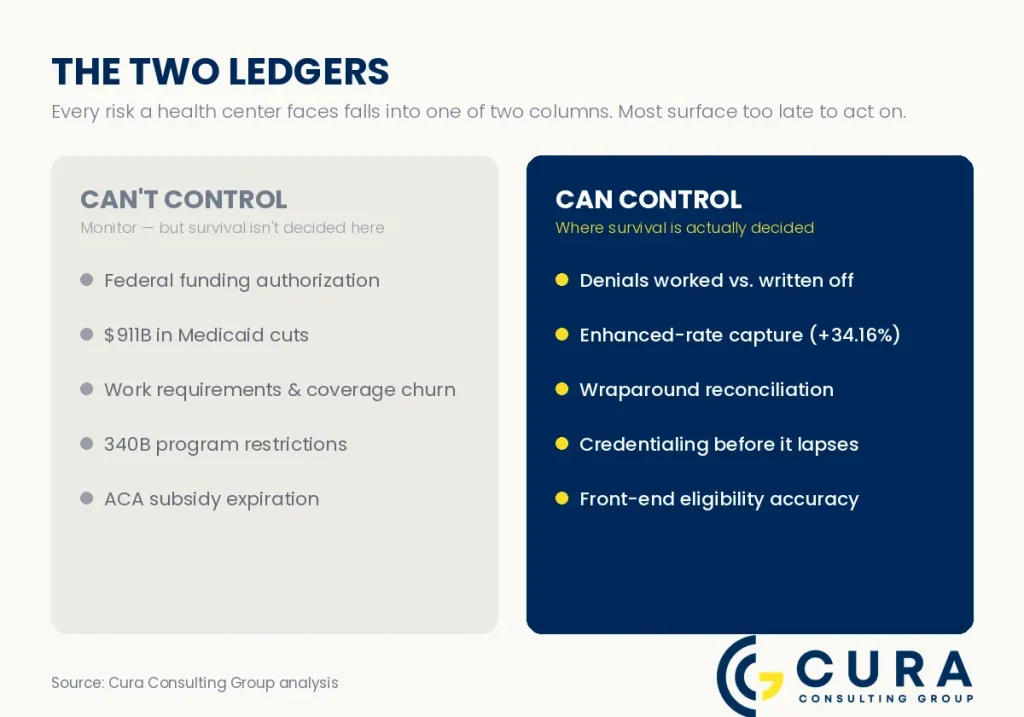
There are two ledgers. You are staffing the wrong one.
Every risk facing your center sits in one of two columns. One you cannot control: the appropriations calendar, the reconciliation law, the 340B rulemaking. The other you can: whether denials get worked or written off, whether eligible visits capture the enhanced rate, whether wraparound gets reconciled against what the MCOs actually owe you, whether a credential lapses before anyone notices it stopped a provider’s billing.
Here is the uncomfortable part. Your board’s attention, your leadership meetings, your anxiety — nearly all of it is allocated to the ledger you cannot change. Almost none of it is on the ledger where the outcome is decided. You are watching the weather and ignoring the leak in the roof.
The math you probably can’t produce
Ask your CFO one question this week: what percentage of the revenue we earned last quarter did we actually collect — and where did the rest go? If the answer takes more than a day, you’ve found your problem. Not because your team is careless — because no one has been resourced to see it.
The leaks are individually small and collectively enormous. Denial rates at centers like yours run 12–15%, and roughly 60% of those denials are never reworked — written off to keep the AR clean. The enhanced rate adds 34.16% for eligible visits, left on the table every day a visit is coded at base. None of it announces itself. That is exactly why it survives.
The centers that survive this decade won’t be the ones that guessed right about Washington. They’ll be the ones that saw their own numbers early enough to act.
WHERE WE WOULD START — IN ORDER
ONE
Separate the ledgers, on paper, in your next leadership meeting. Force every risk into “can control” or “can’t.” The point isn’t the list — it’s watching how much of your organization’s energy is aimed at things you cannot change.
TWO
Demand your capture rate by payer. Not blended. By payer. A healthy blended number routinely hides a single segment quietly hemorrhaging.
THREE
Find your erosion before it reaches the financials. Once margin decline shows up in a monthly statement, the money is gone. The whole game is seeing it while it’s still recoverable.
That last point is why Cura exists. We can show you your own numbers in an afternoon.
See yours → lighthousehealthai.com/early-warning-check
Figures reflect published 2026 industry benchmarks (NACHC, KFF, CMS, and industry revenue-cycle sources) and Cura Consulting Group analysis. Illustrative; individual center results vary. Not financial or legal advice.