

The 2026 federal grant changes are being read as a compliance headache. They’re actually a test of whether your center can produce clean, timely data about itself on demand — and it’s a test most centers are positioned to fail quietly.
Cura Consulting Group Analysis · 2026
Look past the individual rule changes to what they all reward. Agencies are shifting to outcome-based reporting — they want results, not activity. HHS is demanding more detailed budget justifications. Progress reports are more frequent, submissions are digital, audits are more common, and eligibility now hinges on documented organizational capacity and evidence of prior success.
Read together, these aren’t five separate hurdles. They are one requirement wearing five costumes: can you produce accurate, outcome-level data about your operation, quickly, whenever a funder asks?
For community health centers, the stakes are concrete and severe. Your UDS report is due February 15, and it’s the primary mechanism HRSA uses to assess your performance and report to Congress. A late, inaccurate, or incomplete UDS report can trigger a condition on your grant award — up to requiring HRSA prior approval for every drawdown of funds and limits on future funding. And the 2026 UDS itself is changing: Table 9E is moving from cash to accrual, Enabling Services is being renamed Patient Support Services, measures are being elevated into the core set, and quality measures are aligning with CMS eCQMs. Multi-site centers and those who’ve switched EHRs face real data consolidation challenges producing all of this cleanly.
For most centers, the honest answer to “can you produce it on demand” is “not easily.” The data exists, scattered across systems, assembled by hand under deadline pressure. That worked when reporting was lighter and audits rarer. It won’t survive a regime of frequent, outcome-based, audit-backed reporting.
The reframe that changes everything
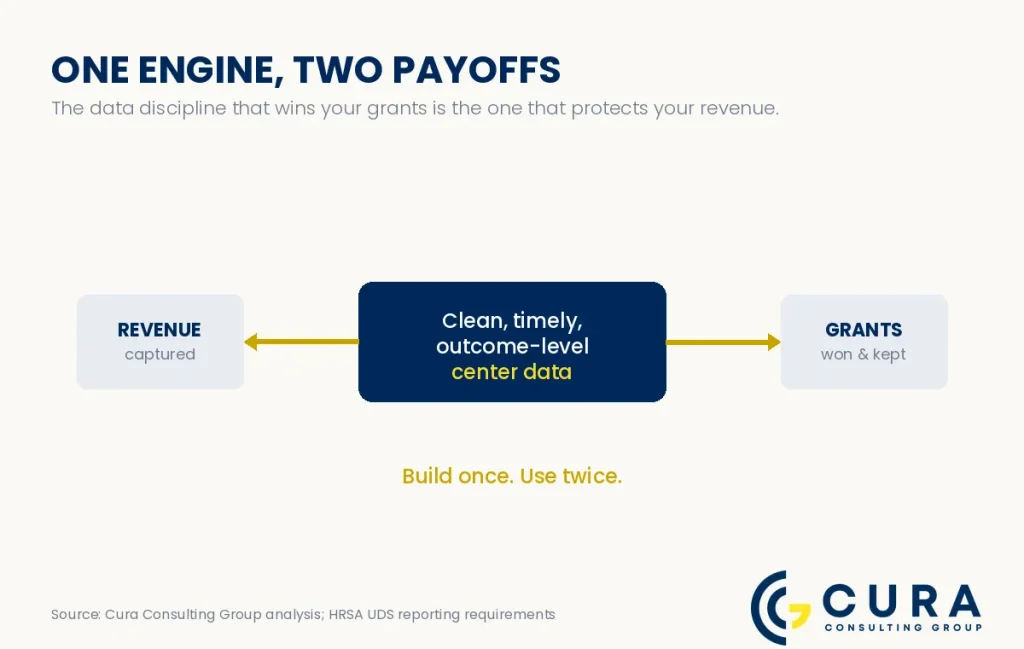
The capability funders now demand — clean, current, outcome-level data on your own operation — is the exact same capability that lets you see your revenue leakage, catch denials before they post, and know your margins in real time. b These aren’t two projects competing for budget. They are one investment with two payoffs.
WHERE WE WOULD START
ONE
Treat your data infrastructure as a strategic asset, not an IT line item. It now determines both your revenue capture and your grant survival.
TWO
Ask whether you can produce your outcomes on demand. If your last UDS or grant report took weeks of manual scramble, that’s not a staffing problem — it’s a visibility problem, and the new audit frequency will expose it.
THREE
Build once, use twice. Evaluate any investment in seeing your own data for both payoffs: revenue captured and grants protected. Solutions that serve only one are half as valuable as they look.
The centers that thrive under the new rules won’t be the ones that hired another compliance specialist. They’ll be the ones that made their own data legible — and discovered that clarity pays them twice.
See how clearly your center can see itself today.
See your data readiness → lighthousehealthai.com/early-warning-check
Figures reflect published 2026 industry benchmarks (NACHC, KFF, CMS, HRSA, and industry revenue-cycle sources) and Cura Consulting Group analysis. Illustrative; individual center results vary. Not financial or legal advice.