

Every public health leader knows the shape of the curve: capacity surges during a crisis, then the money recedes — and the expectations don’t. The emergency-era funding that built dashboards, data teams, community partnerships, and outreach capacity is sunsetting across the country, grant by grant, position by position. What remains is a public that now expects real-time information, partners that expect continued collaboration, and oversight bodies that expect modern reporting — all on budgets drifting back toward their old baselines.
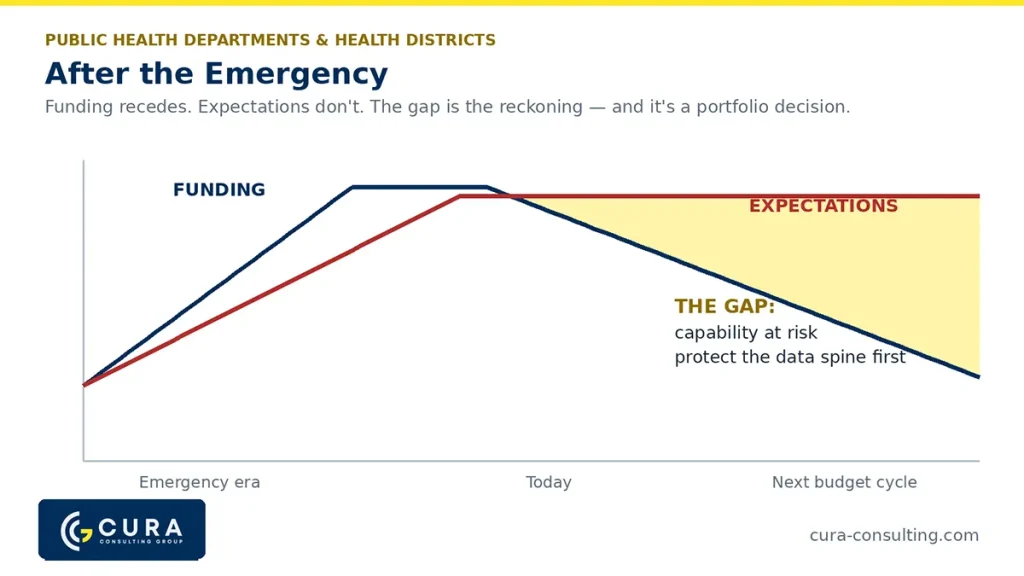
The instinct in a contraction is to cut evenly and quietly. The stronger move — the one we see the best-run departments and districts making — is to treat this as a portfolio decision and make it deliberately.
Know what each capability actually costs and funds. Emergency funding braided many departments’ budgets into complexity: one epidemiologist paid from three grants, a data platform funded through a cooperative agreement that ends next year, outreach staff on a contract nobody owns renewal of. Before anything is cut or saved, leadership needs one honest map: every capability, every funding source, every end date. Departments are routinely surprised by what that map shows — including money left unclaimed and renewals nobody was watching.
Protect the data spine. If the contraction takes the department’s ability to see — its surveillance, its reporting infrastructure, its dashboards — every future response starts from behind, and every funder conversation gets harder. Data capability is also the department’s best argument for itself: the ability to show a county commission or a state legislature exactly what the department prevented, found, and fixed is worth protecting above almost anything else on the org chart.
Turn reporting burden into visibility. Public health answers to more masters than almost any part of the health system — federal cooperative agreements, state offices, local boards, and the public. Most departments meet those obligations manually, late nights included. The same information, organized once and maintained continuously, becomes something better than compliance: a running case for the department’s value, ready whenever the budget conversation turns hostile.
And say the quiet part to your board early. The gap between public expectations and post-emergency budgets is structural, not managerial. Boards of health and county leadership deserve the scenario math now — what stays, what shrinks, what it costs to keep the lights on the data — while there is still room to choose. The departments that frame the trade-offs first tend to keep more of what matters.
Contraction is not destiny for capability. Departments that map their funding honestly, defend their data spine, and make their value visible will come out of this cycle smaller in budget but stronger in standing — and ready for the next surge, which always comes.
Cura works with public health departments and health districts on funding-and-capability mapping, reporting infrastructure, and modernization that survives the grant that funded it. The first conversation is free.