

Credentialing is treated as an administrative function until the day a lapse stops a provider from billing. By then, the money is already gone.
Cura Consulting Group · Executive Brief · 2026
Credentialing failures are among the most preventable revenue losses in a health center, and among the most common — precisely because no one owns them at the leadership level. They live in a spreadsheet until they become a crisis. Four questions surface the exposure.
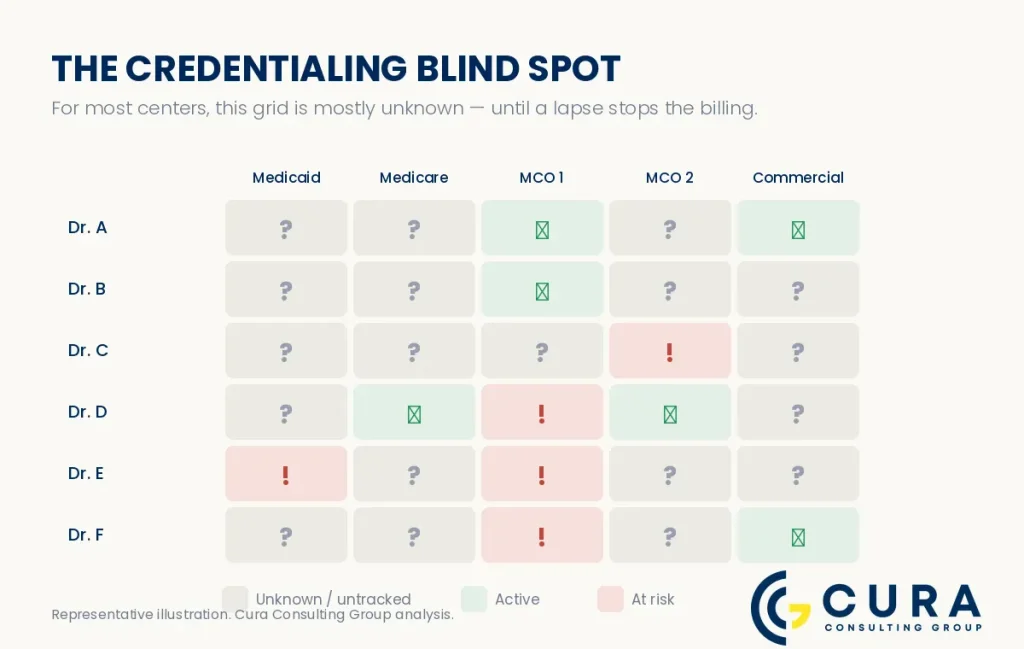
1. For every provider, do we know which payers they’re active with, and when each enrollment expires?
If this lives in one person’s head or an unwatched spreadsheet, you have an unmanaged financial risk, not an administrative task.
2. What is our lead time on an upcoming expiration?
The entire game is catching a lapse on the calendar, with time to act, instead of discovering it in a spike of denials weeks after it happened. If you have no lead time, you have no defense.
3. When a provider sees patients under a payer they’re not active with, how fast do we know?
Every one of those encounters is billing at risk. The gap between the visit and the discovery is pure exposure.
4. Who owns this, at what level?
If the answer is “someone in billing,” it’s under-owned relative to the revenue it controls. Credentialing risk is a leadership-visible financial exposure, not back-office paperwork.
Credentialing isn’t a compliance chore — it’s a revenue-protection function most centers manage reactively and pay for repeatedly. The centers that don’t lose this money simply see the lapse coming.
See your credentialing exposure before it costs you.
See your exposure → lighthousehealthai.com/early-warning-check
Figures reflect published 2026 industry benchmarks (NACHC, KFF, CMS, HRSA, and industry revenue-cycle sources) and Cura Consulting Group analysis. Illustrative; individual center results vary. Not financial or legal advice.